
My Anger is Ruining My Relationship! (Here’s How to Fix It)
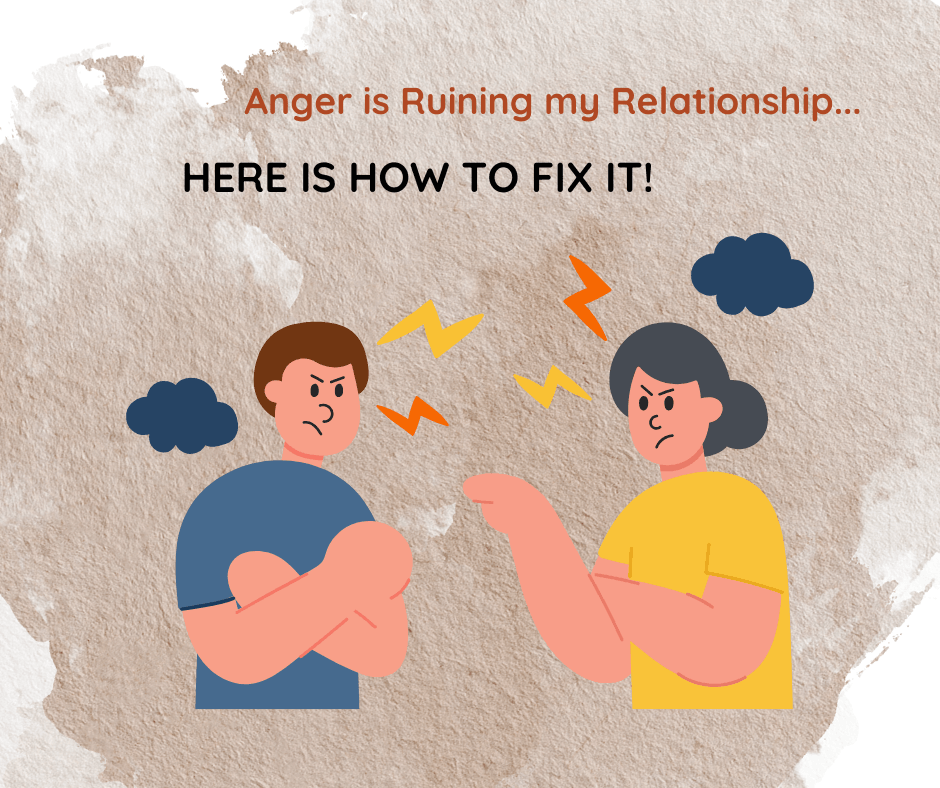
Tossing and turning after a fight with their partner, many of our clients worry, “my anger is ruining my relationship”.
Often, a casual conversation turns into a blow-up, and the client ends up doing something they regret before the fight is over.
They might have said something they didn’t mean or broken something. No matter what they did, they reached a point where they felt completely out of control and now regret every minute of what they did when they lost their temper.
How anger is toxic in relationships
When anger issues have control, the person becomes the “angry partner”. They say and do things that they don’t mean. They hurt loved ones and engage in aggressive behavior to the point it feels like they don’t even know themselves anymore.
The anger reaches a point where the person feels out of control, and they don’t know how to stop themselves. This is when angry response after angry response comes out of their mouth.
After a while, one of the effects of anger is that neither partner feels safe in the relationship. The raised voices and hurtful words ruin any sense of trust the partners had for each other.
This lack of safety creates a distance between the partners. To the point where these anger issues make it so that the partners are no longer genuine with each other.
The partner of the angry person tiptoes around them and keeps secrets to avoid angry episodes and blow-ups.
This makes productive conversations impossible. Hard talks are avoided, and neither partner grows.
The partners begin to see each other as enemies instead of teammates.
Where anger comes from
It feels like it comes out of nowhere, but that’s really not what’s going on. Some factors build up underneath your anger.
Underlying stress
Chronic stress lowers the person's ability to cope when things aren’t going their way. The person is more reactive than when they aren’t stressed.
Chronic stress impacts the person's mental health, making their temper quicker and higher.
An example, if you are struggling at work, your finances aren’t good, and you aren’t sleeping, this makes it more likely that when your partner asks if you did the dishes, you will hear it as criticism and be aggressively defensive.
Unexpressed emotion
Anger is a secondary emotion. This means that anger isn’t the real emotion you’re feeling.
It’s covering up a scarier, more vulnerable emotion like sadness or insecurity.
It’s easier to avoid the vulnerable emotion that feels unsafe by getting angry, which feels safe and protected.
Anger is an all-consuming emotion and is a good distraction from other emotions.
It protects the person experiencing the anger and people around them from exposing the more vulnerable emotion.
For example, a person feels hurt and afraid when their partner stays out later than expected. Instead of acknowledging the underlying feelings, the person gets angry and yells at their partner.
Unprocessed trauma
When a person has experienced traumatic events in the past that they haven’t processed, their nervous system is often dysregulated more easily.
This creates a higher reactivity to instances that mirror the trauma. So there is an incident in your relationship that brings up memories or flashbacks. And the person is responding as though they are in the traumatic event and not in the moment.
When there are past instances of hurt or trauma, you’re trying to protect yourself from it happening again. Your brain looks for any sign that this same thing is going to happen again.
It can misread these signs in body language, tone of voice, or in conversation.
This means that the person reacts to small things as though they are a big deal.
For example, a person's parents left them alone when they were too young to care for themselves. So when the person's partner doesn’t answer their texts, they respond with anger because their trauma brain is telling them that it’s happening again.
Individual anger management techniques
Now that you know what might be underlying your anger issues, let’s look at some healthy ways or coping strategies that you can use to lower your anger. We’ll also talk about ways to manage anger with your partner in the next section.
Here are some effective ways to manage your anger:
Lower your stress and increase your self-care
Stress levels directly impact your ability to control your anger outbursts.
Identify the biggest stressors in your life and problem-solve if there are things you can eliminate or alter to decrease your stress.
You can also use relaxation techniques, like deep breathing, meditation, mindfulness, and progressive muscle relaxation, to decrease your underlying stress.
Try to make sure that you’re consistently engaging in regular self-care like eating, sleeping well, and exercising, as these all help increase your ability to cope with stress.
Examine underlying feelings and learn to express them
The first step is to recognize the feelings that you’re having. The second step is to find a way to express those feelings.
Some ways to express your feelings are talking to someone, journaling, playing music, or creating art.
Expressing the emotions you’re having keeps you from having an emotional outburst.
Know your triggers
A trigger is something that is likely to cause an angry outburst. If you’re aware of what’s happening when you’re triggered, it helps you to decrease your angry responses.
The awareness allows you to communicate about what’s going on or avoid the triggering situation. It gives you the insight to be able to say, I was triggered by the loud noises. Next time, let’s discuss this in a quieter location.
Practice defusion
Defusion is creating distance between you and the thoughts you’re having. It helps you disconnect from the idea that your thoughts are objective reality.
Instead of seeing your thoughts as automatically true, you remind yourself that this is just a thought. That creates enough space for you to be able to observe those thoughts from a more regulated space.
Soothe your nervous system
A dysregulated nervous system is more highly reactive, and it’s more likely that the person is going to get to a point where they are out of control. A regulated nervous system can control emotions better.
A regulated brain has better access to the logical thinking brain.
Some ways to soothe your nervous system are:
- Take a break from stressful situations
- Sit quietly with your feelings
- Distraction yourself
- Relaxation techniques
This can help your nervous system to calm down so that you can respond from a more regulated place.
Clarify your values
Identifying your values helps you to know where your north star is. It allows you to figure out if you’re heading in the right direction.
It also highlights places where it might be time for a change.
When you identify places where your actions are not consistent with your values, you can start to problem-solve.
Accept your feelings
We often place a value on our feelings of good or bad. When we label an emotion as bad, scary, or not okay, then instead of examining it, we suppress or ignore the feeling.
This gives the feeling more power as it will get stronger in order for you to acknowledge it.
If you take a couple of moments to acknowledge the feeling, it will decrease the intensity.
Address underlying mental health issues and trauma
Certain mental health conditions increase reactivity and nervous system dysregulation, making anger problems more likely.
Some of these mental health conditions include posttraumatic stress disorder, anxiety, depression, and bipolar disorder.
Having a history of trauma or negative experiences can also do the same thing.
Treating these underlying conditions with a therapist or psychiatrist can help you decrease angry episodes.
If you think this might be a possibility, it’s important to reach out to an expert and begin treatment.
How to manage anger in your relationship
Here are some couples therapy tips to help you manage your feelings of anger. These skills allow you to build a better relationship and improve your relationship skills.
Build a foundation of friendship
The first step to lowering the anger in your relationship is building a stronger connection. This means increasing positive interactions through purposely doing things that you enjoy together and intentionally communicating positively with each other.
You also want to develop space in your life for your relationship by creating opportunities to spend time together.
It’s also important to start approaching your partner with curiosity instead of assuming you know what your partner is thinking.
You also want to go out of your way to help your partner feel appreciated and seen.
A lot of this makes a huge difference in helping you feel more connected and means that you will be less triggered by interactions with them.
Use a gentle start with tough conversations
An important skill for both members of the couple, not just the angry partner. When you’re approaching a topic that might be heightened emotionally, it’s important to start slow.
Instead of immediately hitting the ground running, you start with an “I feel” statement or couch the beginning of the conversation, recognizing this might be a tough one.
Take responsibility for your part
Fights don’t happen in a vacuum, and they’re never just the fault of one member of the couple. When you take responsibility for your part of the disagreement, you allow your partner to do the same, even when your part was only 10%.
When we get stuck in the idea that the problem is all the other person's fault, we don’t allow room for flexibility on either partner’s side of things.
Share what you value in your partner
You’re in this relationship for a reason. Help your partner to know that you still see them and appreciate them by sharing what you value about them. This helps in several ways.
It helps the other partner feel seen and valued.
This also allows you to notice and remember the reasons you chose this person as your partner.
No matter how long it’s been, some of those qualities still exist; you just have to look for them. If you value the person across from you, it’s easier to hold your tongue when that anger starts washing over you.
A note here, this isn’t something that you do in the middle of a fight or a disagreement, but something you do when everything is calm.
Learn to recognize repair attempts and return them
It’s also important to recognize when your partner is trying to step back from the tension of the fight.
Your partner might have their own individual way of doing this, but some common approaches to making things better are humor or acknowledgement.
If you learn to see when your partner is doing this and then you respond in a similar fashion, the two of you start building towards peace instead of a fight.
Take time-outs with intention and within a time frame
When you find that your body is starting to get overwhelmed with anger, it’s time to take a time out. But how you utilize the time out and communicate about it is important.
You want to take the time out with the idea that you’re helping yourself calm down, so that you can come back to the conversation quickly and continue.
Some people are able to do this in 20 minutes, and some people need quite a bit more time. The important part is that you aren’t using this time to avoid the conversation.
You also need to communicate to your partner that you will come back to the conversation and when. It’s important that you come back to it within 24 hours. This prevents the topic from getting swept under the rug and keeps the resentment from building.
Listen to your partner
Often, when we struggle with anger issues, we let the anger flood our bodies before we even really know what the conversation is about.
We also let our past experiences and trauma-based assumptions color what we’re taking from the conversation.
One way to make sure you’re hearing your partner correctly is to use active listening skills and repeat back in your own words what you think your partner is saying.
Express anger without attacking your partner
When you’re angry, it’s important to take a deep breath and express your anger in a way that doesn’t put them on the defensive.
One way to do that is to use “I” statements and to focus on your experience, not on what you assume your partner's intent is.
If you get to a point where you’re unable to do this, then it’s important that you utilize the time-outs mentioned above.
Notice and turn towards bids for connection
The last part of this that can be very helpful, even in difficult conversations, is to notice bids for connection and attempt to respond with your own attempt to connect, or at least don’t leave your partner hanging.
Even if you don’t feel like it, hugging your partner will help you to remember that you care about the person you’re having this intense conversation with.
When to seek help
If you’re feeling like your anger is destroying your relationship, then it’s important to know when to reach out for professional help. Self-help strategies are helpful to a point, but at some point, that might not cut it.
In the case of verbal abuse or a physically abusive relationship, it might be necessary to physically separate while you receive anger management.
Here are red flags that you need to seek professional help:
- You feel out of control
- Self-help strategies aren’t denting it
- You want the support and accountability
- You're at a breaking point, or your partner is thinking about leaving
- Your trauma or stress is impacting your life, and you can’t seem to change it
You can seek out professional help with your anger through anger management classes, individual classes, or couples counseling. The best way to approach this is to use all three.
How to get help
When you’re seeking help, look for an anger management therapist who is comfortable treating anger and understands how to treat it either individually or as part of a couple. ACT is helpful for individual therapy for anger issues. When it comes to couples therapy, Gottman will help you to get your relationship back on stable feet.
If you’re still thinking to yourself anger is ruining my relationship and I need to find help, it’s probably time to reach out for help. Comfort in Mind can help with Gottman couples therapy or individual therapy with Schema Therapy.